New year, new you. Much is made of the passage of time around this time of year, and it got me thinking: Why? The transition from December 31 to January 1 is not actually a new year for anyone except those born on January 1; my "new year" on this planet doesn't start until March. And if you're still in school, the transition from summer break into the start of the school year is far more meaningful than "New Year's."
Perhaps most importantly, there's no actual data to suggest that January 1 is any sort of anniversary for anything on this planet. It's not like the Big Bang – or if you prefer, "the moment we all became a twinkle in God's eye" – happened on January 1... however many years ago that was.
Actually, the more you dig into our measurement of time, the more you realize we've all been indoctrinated into a system of thinking that's not grounded in much science at all.
Do you ever think how crazy it is that we universally agreed to measure time by the birth of one human?
(I recognize that "agreed" is doing a lot of heavy lifting in that question – ignoring a lot of hard and soft power that went into establishing such universality – but stay with me.)
Time is a concept. And a lot of what we accept as universally true about time is only fairly recently the standard, as far as human history goes. And it's unequivocally wrong.
The Before/Common Era (BCE/CE) dating system was first used in the 17th century as a replacement for the Before Christ/Anno Domini (BC/AD) system, which refers to the birth of Jesus Christ, though no one knows if accurately. BCE/CE refers to the same event but by a more politically correct ("inclusive") nomenclature, though I think this is actually pointless, because no one can explain what the "common era" is without explaining that it starts with the supposed birth of the historical figure Jesus Christ. Actually the fact that we still measure time as having "started" when Jesus was born isn’t inclusive at all, and changing the label without changing the meaning and measurement is performative. It actively erases every other cultural calendar which exists.
If you travel, some museums will list dates in an additional measurement, based on the local culture or religion, ie: the Mayan calendar, or the Chinese. So this "common era" is really only "common" in the way that English is "common". It is a common language most people fall back on to make things easier in the age of globalization, but by no means the only – or even the best – way.
Still, it is pretty crazy that for all of the advancements of science, we are still using a religious measurement for the calendar year that we know to be inaccurate. If we started at the beginning of earth, it’s really the year 4,540,000,000 – plus or minus a handful of years. We could also make the argument to start at the beginning of human existence, which would be… too logical, maybe, too "inclusive," as opposed to starting at the beginning of one human’s estimated existence.
A writer for Popular Mechanics argues that 80 percent of human history occurred more than 2026 years ago. He argues that we should add 10,000 years to the calendar and begin human history at the building of the first temple – the first major construction of humankind – making the date 12,026. I find his argument valid, particularly because we don’t have exact agreement on who the first human is, rather, we have a series of first humans, the first beings to look and behave noticeably less apelike based on their skeleton shapes and the tools discovered in the earth nearby. Construction is a fairly decent marker of humanhood, a sizable achievement in evolution. Though again, dating the first major construction of humankind could be wrong – we never know what we might discover in the future.
No matter what date we choose, it is inaccurate, because our systems of measurement are merely estimates, only as accurate as the scientific methods we have developed, and still subject to human error. Meanwhile we had great swaths of people in the run up to Y2K getting worked up about the end of the world. Even if our current measurement of time was accurate, it wasn’t even actually the year 2000. It was the year 1999, because we skipped the year 0. The BC/AD calendar goes from 1 BC to 1 AD. I can’t decide which is the bigger hoax – Y2K or our measurement of time altogether.
What I find most objectionable about time, though, is the decision to place Jesus’s birthday in December. If we're going to pick a random date to celebrate, at least pick a good date. It’s barely even a white Christmas in December. Wouldn’t winter be so much more palatable if we had something to celebrate in February? I could use decorations and presents in the dead of winter, not the beginning of it, and so close after Thanksgiving, which, again, is another randomly dated holiday.
(Please forgive the northern hemisphere and United States centrism of the previous paragraph by the way, though I’d be keen to know if those who live below the equator would prefer an end of summer holiday rather than a beginning of summer holiday – it’d be like the equivalent of bookending summer with Memorial Day and Labor Day in the U.S., except it’d be New Years and then Christmas. Sounds nice, right?)
My issue with our measurement of time is not limited to years and holidays. It goes right down to the second.
Why do seconds tick at the speed that they do?
A second is 1/86,400 of the time that it takes Earth to rotate once on its axis, calculated by 24 hours divided by 60 minutes divided by 60 seconds. It’s not totally accurate, however, because the speed of Earth’s rotation is not constant. (Yes, that’s right.) Did you know weather changes the speed of the Earth’s rotation? And though we’ve tried to predict the weather, it has become more unpredictable as we have disrupted our ecosystem and thereby our weather patterns, making our measurement of time an ever moving target. Not that we’re moving time to try to keep up with it. We value – and by extension, the stock market values – consistency of time over accuracy.
We have a much more complicated – and also more accurate – way of measuring seconds than a now-outdated understanding of the speed of the Earth’s rotation. Scientists now define a second using the vibration of certain atoms, but of course no one agrees on which atoms to use, or how many vibrations count. So instead, we go with 24’s and 60’s (because that makes sense??? More on that in a… second…) and some years we have leap seconds to correct our perceived drift from the actual rotation of the Earth, which is expensive for financial and computing institutions to incorporate into their calculations, which is also, mind you, another thing humans made up.
Are you still with me? 😅
So why measure time by dividing by 24 and then pivot to measurements of 60? Could you imagine if a second was 24 divided by 24 divided by 24? Again, is that too logical? Imagine a world where our understanding of a "minute" was the equivalent of today’s 2.5 minutes, and our "seconds" are the equivalent of 6.25 seconds.
It seems to me that humans have become quite attached to – even hyper fixated on – controlling and predicting the measurement of something that the Egyptians and Babylonians made up simply by watching the sun moving in the sky and wanting to make sense of it. We'd rather be consistent and wrong, than adaptable and, well, slightly less wrong.
The only reason we need any of this – seconds, years, historical dates – is because we have become attached to structure, to organizing principles, which I would argue, is a problem.
Life is not predictable, controllable, or structured.
Our attachment to making it so causes us suffering when life is life.
In summary, here’s what I’ve learned after my deep dive into the rabbit hole of time:
- We have no fucking clue when Jesus was born.
- We have no fucking clue what year it is.
- What is logical or makes sense is not always what is standardized or accepted, which is maybe the most, on-brand reality in a world where the Earth rotates at whatever fucking speed it decides to based on... the weather.
- Time is a made up concept anyway.
Any questions, class? 😂
And now, for your homework: In a time of the year where everyone is measuring their accomplishments and goals by an arbitrary deadline – how would your life be different if you eliminated measurements of time altogether?
It's a thought experiment in how we change our behavior based on the perception of time. Without time, maybe you’d treat every day like it’s your birthday, every moment a reason to celebrate, because it feels more unpredictable, more wild... Am I 13 or am I 33? Who knows and who cares?
Because without time to dictate what is past and what is future, where we were and where we need to be, we are placed firmly in the eternal present.
There is only ever now.
Every moment is an opportunity to begin again. And that is a concept I can get behind.
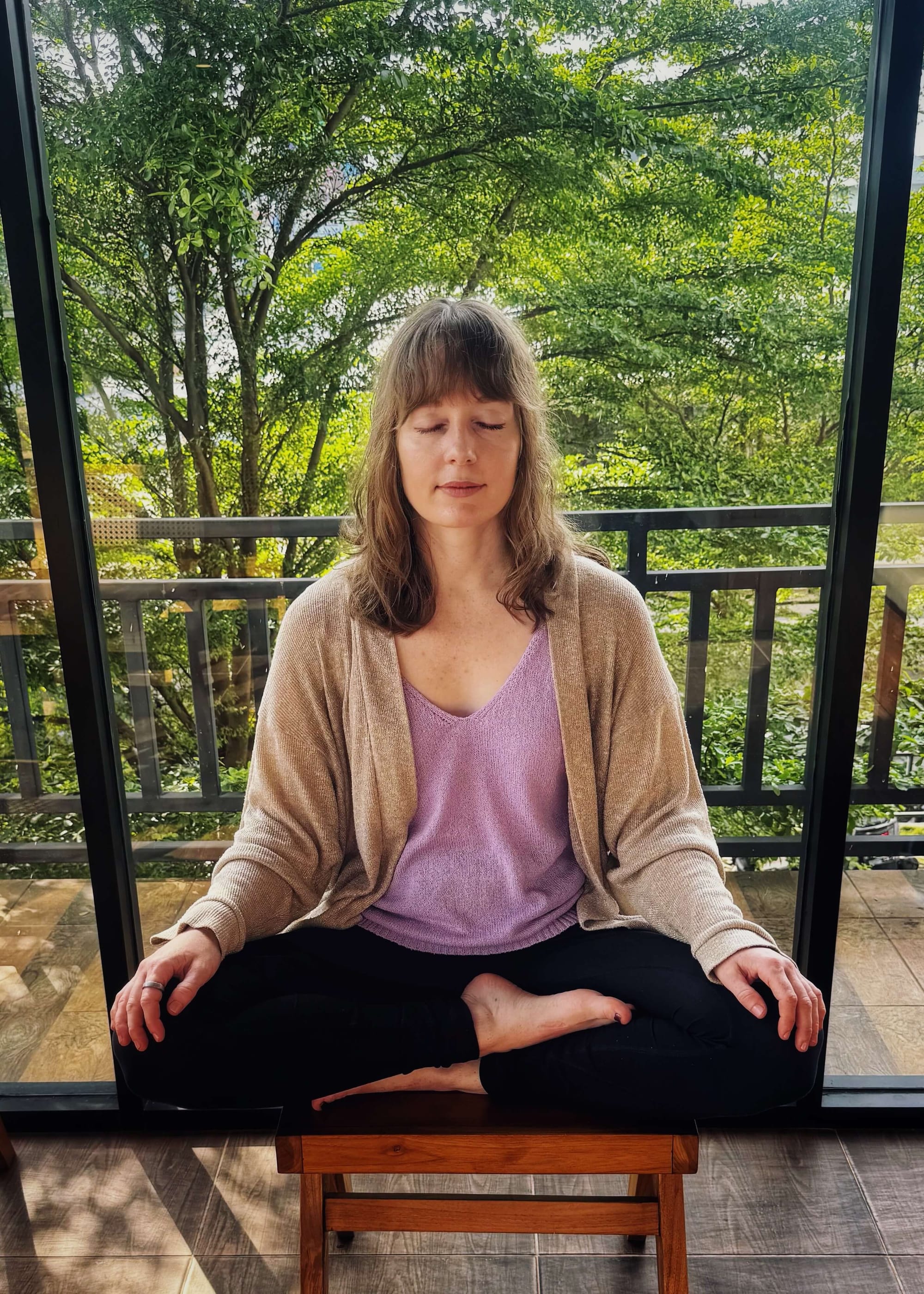
Time is a construct and there's really only one place to live: the present moment. Meditation is the most reliable way I know to actually get there — to come back to yourself, to settle your mind, and to meet your life as it’s unfolding right now.
I'm thrilled to be launching my new offerings as a RYT-200 certified meditation teacher! I'm officially open for private, 1:1 meditation coaching (guided meditations to help you meet whatever is arising in your daily life with clarity, peace and courage) and teaching (giving you the toolkit to build a more consistent meditation practice that you can do yourself). I am currently offering private sessions on a per-hour sliding scale, so reply to this email if that's something you're interested in and we can chat to see if it's a good fit!
In the new year, I will be offering a group How to Meditate class, that will teach the fundamentals of meditation and how to build a daily practice. This course will be accessible to beginners and seasoned meditators who are looking to spruce up their practice. If you're interested in being added to the waitlist for that class, reply to this email and let me know!